
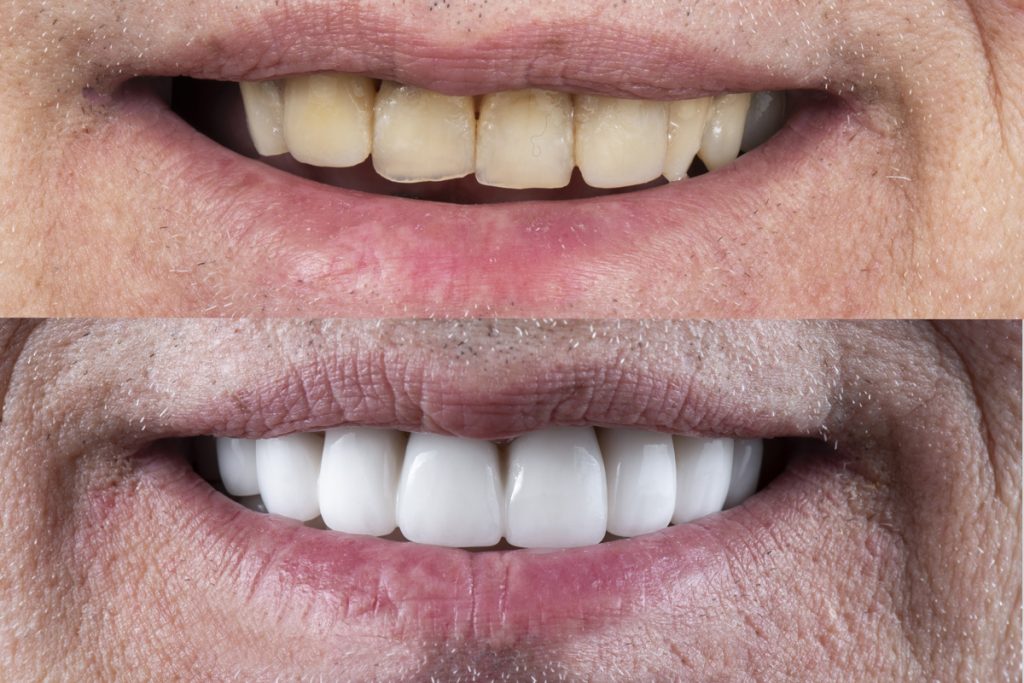
Porcelain Veneers in Frisco, Texas
A veneer is a thin shell of porcelain bonded to the front of a tooth. It covers chips, permanent stains, small gaps, and minor misalignment in a way no whitening treatment or filling can. At Forest Dental Cafe in Frisco, Dr. Demian Kim designs veneers to look like teeth rather than like veneers — and backs the work with a five-year guarantee.
Veneers are also one of the few dental treatments that are genuinely irreversible. This page covers what they do well, what they do not, and the questions worth asking before you commit.
What Veneers Can and Cannot Fix
Veneers work well for:
- Chipped or worn front teeth
- Stains that do not respond to whitening — tetracycline discoloration, fluorosis, or an internally darkened tooth
- Small gaps between front teeth
- Teeth that are slightly too short or uneven in shape
- Minor crowding or rotation, where the teeth are close to aligned already
Veneers are the wrong tool for:
- Significant crowding or bite problems. Moving teeth with Invisalign first — or instead — is usually the better answer, and often the more conservative one.
- Teeth with large existing fillings or extensive decay. A crown restores those properly; a veneer bonded over a compromised tooth will not hold.
- Active gum disease or untreated decay. Both are addressed before any cosmetic work begins.
- Severe grinding, unless the grinding is managed first. Porcelain is strong but it is not indestructible, and an unmanaged clenching habit will find its limit.
If your goal can be reached with whitening, bonding, or orthodontics instead, Dr. Kim will tell you. Removing enamel is permanent, and it is not the right first move for every smile.
Veneers vs. Crowns vs. Bonding
These three get confused constantly. The difference comes down to how much tooth is involved.
| Veneer | Crown | Composite Bonding | |
|---|---|---|---|
| Covers | Front surface only | Entire tooth | Small area being repaired |
| Tooth structure removed | Minimal — front surface only | Substantial — all sides | Little to none |
| Material | Porcelain | Porcelain or zirconia | Composite resin |
| Best for | Cosmetic changes to healthy teeth | Damaged or heavily filled teeth | Small chips, quick fixes |
| Stain resistance | High | High | Lower — stains over time |
| Typical lifespan | 10–15+ years | 10–15+ years | 3–7 years |
| Appointments | Usually two | Usually two | Often one |
| Reversible | No | No | Largely yes |
The honest summary: bonding is the least invasive and the least durable. A crown is the most invasive and is chosen when the tooth needs the structural support, not when the goal is appearance. A veneer sits between them and is the right answer when a healthy tooth simply does not look the way you want it to.
Will Veneers Ruin My Teeth?
This question comes up in almost every consultation, and it deserves a straight answer rather than reassurance.
Getting veneers is permanent. Most veneers require removing a thin layer of enamel — typically around half a millimetre — so the porcelain sits flush rather than bulking the tooth outward. Enamel does not grow back. Once a tooth is prepared for a veneer, it will need a veneer or a crown on it for the rest of your life.
That is not the same as damaging the tooth. A properly prepared and bonded veneer protects the tooth surface underneath and, in many cases, is stronger than the worn or chipped enamel it replaced. Problems come from poor preparation, poor bonding, or veneers placed on teeth that were not good candidates in the first place — not from the concept.
Some cases need very little preparation. Where teeth are slightly undersized or worn, minimal-preparation veneers are sometimes possible. Whether that applies to you depends on the shape and position of your existing teeth, and it is something Dr. Kim assesses at the consultation rather than promises in advance.
The right way to think about it: veneers are a commitment, not an experiment. That is exactly why the planning stage matters more than the placement.
A Note on Dental Tourism
Frisco patients regularly ask about traveling abroad for veneers, drawn by package pricing that looks impossible to match locally.
A few things worth knowing before you book:
“Veneers” abroad are frequently crowns. Full-coverage crowns are faster to prepare and more forgiving of imprecision, so many overseas package treatments aggressively reduce healthy teeth down to stumps and cap them. That is a far larger and more permanent intervention than a veneer, and it is often not explained clearly beforehand.
Compressed timelines skip steps. Preparation, temporary placement, and final bonding done across a few days leaves no room for the tooth to settle, no trial period, and no chance to adjust the shape after you have lived with it.
Aftercare is the real cost. If a veneer debonds, chips, or the bite feels wrong six months later, the dentist who placed it is on another continent. Correcting someone else’s cosmetic work is more expensive and more difficult than doing it once, properly.
We are not going to tell you every overseas clinic is bad. We will tell you that the price difference usually reflects a difference in what is actually being done to your teeth, and that you should ask specifically whether you are receiving veneers or crowns before you agree to anything.
The Veneer Process, Step by Step
1. Consultation and smile design. Dr. Kim examines your teeth and gums, listens to what you want changed, and tells you honestly whether veneers are the right approach. This is where we establish shape, length, and shade — and where we rule out anything that needs treating first.
2. Preparation. A thin layer of enamel is removed from the front of each tooth receiving a veneer, done under local anesthesia. Impressions are taken and sent to the lab.
3. Temporaries. You leave with temporary veneers. These matter more than patients expect — they are a preview. If something about the length or shape does not feel right while you are living with them, that feedback goes to the lab before the final porcelain is made.
4. Placement. Your final veneers are tried in, checked for fit, shade, and bite, and then bonded. Adjustments happen at this visit, not after.
5. Follow-up. We check the veneers at your regular cleanings and watch the gum margins over time.
Most cases take two to three weeks from preparation to placement.
How Long Do Veneers Last?
Porcelain veneers commonly last 10 to 15 years, and many last considerably longer. What ends a veneer’s life is rarely the porcelain itself.
What shortens their lifespan:
- Grinding and clenching. The most common cause of chipped or debonded veneers by a wide margin. If you grind, a nightguard is part of the treatment plan, not an optional add-on.
- Using teeth as tools. Opening packaging, biting nails, chewing ice.
- Gum recession. As gums recede over years, the veneer margin can become visible. Consistent hygiene slows this significantly.
- Decay on the remaining tooth. The veneer does not decay. The tooth underneath still can.
What extends it: normal brushing and flossing, regular cleanings, and a nightguard if you need one. Veneers require no special products.
Our Five-Year Guarantee
Dr. Kim provides a five-year guarantee on the dental work he performs, including veneers. The industry standard is considerably shorter, and many practices offer no written guarantee at all.
Cosmetic work is where that commitment gets tested. A veneer that looks good on placement day but has a visible margin in two years was not planned carefully enough. Offering a five-year term changes how a case gets approached — it makes the extra try-in appointment and the extra shade check worth it, because rushing simply moves the cost to later.
Every case is different, so the specific terms are reviewed with you in person as part of your treatment plan, in writing, before you agree to anything.
Paying for Veneers
Cost depends on how many teeth are involved and what each one needs. Dr. Kim gives you the full cost in writing at your consultation, before you commit.
One thing to be aware of: veneers placed purely for appearance are generally not covered by dental insurance, since insurance covers function rather than aesthetics. Where a tooth is chipped or damaged, part of the treatment may qualify — we verify your benefits and tell you exactly where you stand rather than letting you find out afterward.
- CareCredit. Monthly payment plans, including interest-free options for qualifying patients.
- FSA and HSA. Eligibility depends on whether treatment is restorative. We can tell you which category your case falls into.
- Our in-house membership plan. For patients without dental insurance. Includes two cleanings, two exams, necessary x-rays, and a discount on treatment. Plans start at $100 per year.
Call 214.469.1001 to talk it through.
Frequently Asked Questions About Veneers
How many veneers do I need? It depends on how many teeth show when you smile and what is bothering you. Some patients need one veneer to match a single damaged tooth. Others do six to ten across the front. Dr. Kim will show you what each option looks like rather than starting from a number.
Do veneers look fake? They look fake when they are too white, too uniform, and too flat — all of which are choices made during planning, not inherent to the material. Natural teeth vary slightly in shade and have surface texture. Veneers designed with that in mind are difficult to identify as veneers.
Does getting veneers hurt? Preparation is done under local anesthesia, so you should not feel pain. Some patients have mild temperature sensitivity while wearing temporaries, which resolves once the final veneers are bonded.
Can I whiten my veneers later? No. Porcelain does not respond to whitening agents. This is why shade is decided before the veneers are made — and why patients who plan to whiten should do it first, so the veneers can be matched to the lighter shade.
What happens if a veneer chips or comes off? Call us. A debonded veneer that is intact can often be re-bonded. A chipped one usually needs replacing. Do not try to reattach it yourself, and keep the piece if you have it.
Are veneers better than whitening? Not better — different. If your teeth are healthy and well-shaped and you simply want them lighter, whitening is faster, cheaper, and reversible. Veneers are for changing shape, covering chips, or treating stains that whitening cannot lift.
How long do I have to wait between appointments? Usually two to three weeks while the lab fabricates your veneers. You wear temporaries during that time and can eat and speak normally.
Can I get veneers if I grind my teeth? Often yes, but the grinding is addressed first. That usually means a nightguard as part of the plan. Placing porcelain over an unmanaged clenching habit is how veneers fail early.
Schedule a Veneer Consultation in Frisco
Forest Dental Cafe serves patients throughout Frisco, Little Elm, The Colony, Prosper, and north Plano. We offer evening appointments and every-other-Saturday hours.
Cosmetic treatment should start with a conversation, not a quote. Come in, tell us what bothers you when you look at your smile, and we will tell you honestly what it would take to change it — including when the answer is something simpler than veneers.
Call 214.469.1001 or request an appointment online.
8075 FM 423, Suite 110, Frisco, TX 75036