
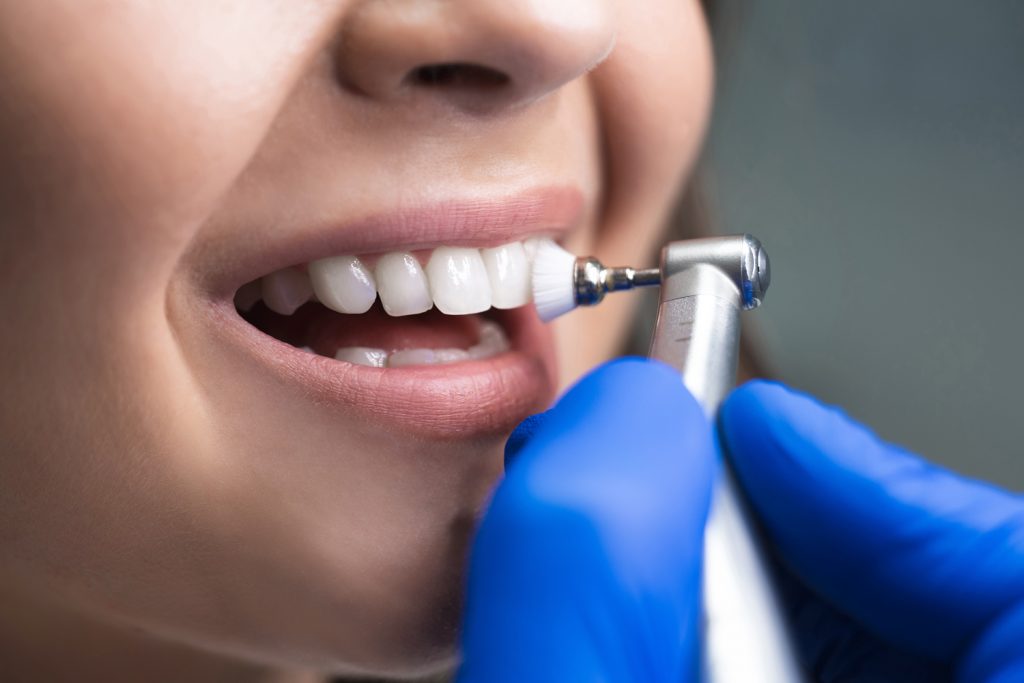
Teeth Cleaning in Frisco, Texas
A professional cleaning removes what brushing and flossing cannot reach — hardened tartar below and between the teeth, and the bacterial film that drives gum disease. At Forest Dental Cafe in Frisco, Dr. Demian Kim provides routine cleanings, deep cleaning for gum disease, laser gum therapy, and ongoing periodontal maintenance.
Most people think of a cleaning as the appointment where their teeth get polished. It is also the appointment where problems get caught while they are still small — and where gum disease, which is painless until it is advanced, gets found at a stage when it can still be reversed.
Gingivitis and Periodontitis Are Not the Same Thing
This distinction decides everything about what happens next, and most patients have never had it explained.
Gingivitis is inflammation of the gums. It is fully reversible. Gums bleed, look red or puffy, and may be tender. No permanent damage has been done. A thorough cleaning and better home care returns the tissue to health, usually within weeks.
Periodontitis is bone loss. It is not reversible. When inflammation goes untreated, it moves below the gumline and the body begins destroying the bone anchoring the teeth. Pockets form between gum and tooth, bacteria colonize them, and the process feeds itself. Treatment stops the progression and lets the tissue heal — but the bone that is gone does not come back.
The gap between them is where nearly all adult tooth loss happens, and it is almost entirely painless. That is the difficult part: by the time something hurts, you are usually past the reversible stage.
If your gums bleed when you brush, that is stage one and it is fixable. It is not normal, and it does not resolve on its own.
Routine Cleanings
A routine cleaning — a prophylaxis — is for patients whose gums are healthy or have mild inflammation only.
Tartar is removed from above and just below the gumline using an ultrasonic scaler and hand instruments, and the teeth are polished. Your gums, teeth, and existing dental work are examined at the same visit.
How often? Twice a year suits most adults. Some people build tartar quickly, and patients with a history of gum disease need a shorter interval. We will tell you which you are based on what we actually see rather than applying one rule to everyone.
Deep Cleaning: Scaling and Root Planing
When gum disease has progressed past what a routine cleaning reaches, the treatment changes.
What it is. Tartar and bacterial deposits are removed from the root surfaces below the gumline, and those surfaces are smoothed so gum tissue can reattach and pockets can shrink. The area is numbed, and treatment is usually split across two visits — one side of the mouth at a time.
Why it is not just “a longer cleaning.” A routine cleaning works above the gumline and in the shallow space just beneath it. Scaling and root planing works inside periodontal pockets that can be several millimetres deep. It is a different procedure with a different purpose, which is why it is coded and billed differently by insurance — a point that confuses a lot of patients.
How we know you need it. Pocket depths are measured with a probe at specific points around each tooth, and x-rays show the bone level. Those numbers, not an opinion, are what determine the diagnosis. We will show you yours.
Laser Gum Therapy
Alongside scaling and root planing, we use a dental laser to treat the periodontal pockets.
What it does. The laser is directed into the cleaned pocket to reduce bacteria and remove diseased tissue lining the pocket wall, which instruments cannot address directly.
Honest framing. Laser therapy is an adjunct to scaling and root planing, not a replacement for it. Removing the tartar mechanically is what makes the treatment work; the laser supports that. Research on how much additional benefit it provides is mixed, and any practice telling you a laser alone will cure gum disease is overselling it.
We use it because it is low-risk, requires no additional appointments, and the potential benefit in reducing bacterial load is worth having. We are not going to claim more for it than that.
Chlorhexidine Rinse
After deep cleaning, we often prescribe a 0.12% chlorhexidine gluconate rinse. It is an antimicrobial that reduces bacteria in the mouth while the gum tissue heals.
Two things to know. It is used for a defined period — typically a couple of weeks — not indefinitely. And it can cause temporary brown staining on the teeth with extended use, which is removed at your next cleaning. Both are expected, and we will tell you exactly how long to use it.
Periodontal Maintenance: The Part Patients Resist
After scaling and root planing, you do not go back to cleanings every six months. You move to periodontal maintenance every three to four months.
Patients push back on this, and the reason it matters is simple biology: the bacteria that caused the disease recolonize the pockets in roughly ninety days. Six-month intervals let them re-establish and the destruction resumes. Three-month intervals interrupt that cycle.
This is not an upsell. It is the difference between treatment that holds and treatment that has to be repeated in two years, and it is the single strongest predictor of whether someone keeps their teeth after a periodontitis diagnosis.
Periodontal maintenance is also billed differently from a routine cleaning, and most dental plans cover it at a set frequency. We will verify what yours allows.
Why Gum Health Affects the Rest of Your Treatment
Gum disease is not a standalone problem. It changes what else is possible.
- Dental implants need healthy bone and tissue to integrate and hold. Active periodontitis has to be treated first.
- Invisalign applies force to teeth. Moving teeth in bone weakened by periodontal disease can loosen them permanently.
- Veneers and crowns are bonded at the gumline. If that tissue is receding, the margin becomes visible within a few years.
- Dentures rest on the ridge that periodontal disease erodes.
This is why gum health is assessed before cosmetic or restorative treatment is planned, rather than after.
What You Can Do at Home
Brush twice daily for two minutes, angled toward the gumline rather than straight at the tooth. That angle is where the difference is — plaque at the gum margin is what drives inflammation.
Clean between your teeth daily. Floss, interdental brushes, or a water flosser — whichever you will actually use consistently beats the one you will not. A toothbrush reaches roughly 60% of tooth surface. The rest is between.
Bleeding is a signal to clean more, not less. Almost everyone does the opposite — they see blood and avoid the area, which makes it worse. Inflamed tissue bleeds; consistently cleaned tissue stops bleeding within about two weeks.
Smoking is the largest modifiable risk factor for gum disease, and it also masks the warning signs — nicotine constricts blood vessels, so gums bleed less even as the disease advances.
Watch for dry mouth. Many common medications reduce saliva, which is the mouth’s main defense. Tell us what you take.
Paying for Cleanings and Gum Treatment
- Dental insurance. Preventive cleanings are covered at a high percentage by most plans, often 100%, typically twice a year. Scaling and root planing and periodontal maintenance are covered differently — we verify your specific benefits and tell you what you will owe before treatment.
- Our in-house membership plan. For patients without dental insurance. Includes two cleanings, two exams, necessary x-rays, and a discount on treatment. Plans start at $100 per year — which is why it makes sense for anyone paying out of pocket for regular care.
- CareCredit. Monthly payment plans for larger treatment.
Call 214.469.1001 and we will go through it.
Frequently Asked Questions
How often should I get my teeth cleaned? Every six months for most adults. Patients who build tartar quickly, smoke, or have a history of gum disease need a shorter interval — often every three to four months.
Why do my gums bleed when I brush? Bleeding means inflammation, which means bacteria at the gumline. It is the earliest and most reversible stage of gum disease. It is not normal, and it will not resolve by leaving the area alone — consistent cleaning usually stops it within a couple of weeks.
What is the difference between a regular cleaning and a deep cleaning? A regular cleaning works above and just below the gumline. A deep cleaning — scaling and root planing — works inside periodontal pockets, on root surfaces beneath the gum, with the area numbed. They are different procedures for different stages of disease.
Does scaling and root planing hurt? The area is numbed, so you should not feel pain during treatment. Some tenderness and temperature sensitivity for a few days afterward is normal as the tissue heals.
Do I really need cleanings every three months after a deep cleaning? Yes, and it is the single most important factor in whether the treatment holds. The bacteria recolonize the pockets in about ninety days. Six-month intervals let the disease restart.
Can gum disease be cured? Gingivitis can be fully reversed. Periodontitis can be stopped and controlled, but the bone already lost does not regrow. This is why catching it at the bleeding-gums stage matters so much.
Will a cleaning whiten my teeth? A cleaning removes surface stain from coffee, tea, and tobacco, so teeth often look noticeably brighter afterward. It does not change the underlying shade — that requires whitening.
I have not had a cleaning in years. Is it going to be bad? It may take longer, and we may split it across two visits. You will not be lectured. A lot of patients come in after a long gap, and where you go from here is what matters.
Can I get a cleaning while pregnant? Yes, and it is recommended. Pregnancy hormones make gums more prone to inflammation, and untreated gum disease during pregnancy has been associated with poorer outcomes. Let us know you are pregnant and how far along.
Book a Cleaning in Frisco
Forest Dental Cafe serves patients throughout Frisco, Little Elm, The Colony, Prosper, and north Plano. We offer evening appointments and every-other-Saturday hours.
If it has been a while, or if your gums have started bleeding, that is exactly the right time to come in.
Call 214.469.1001 or request an appointment online.
8075 FM 423, Suite 110, Frisco, TX 75036