
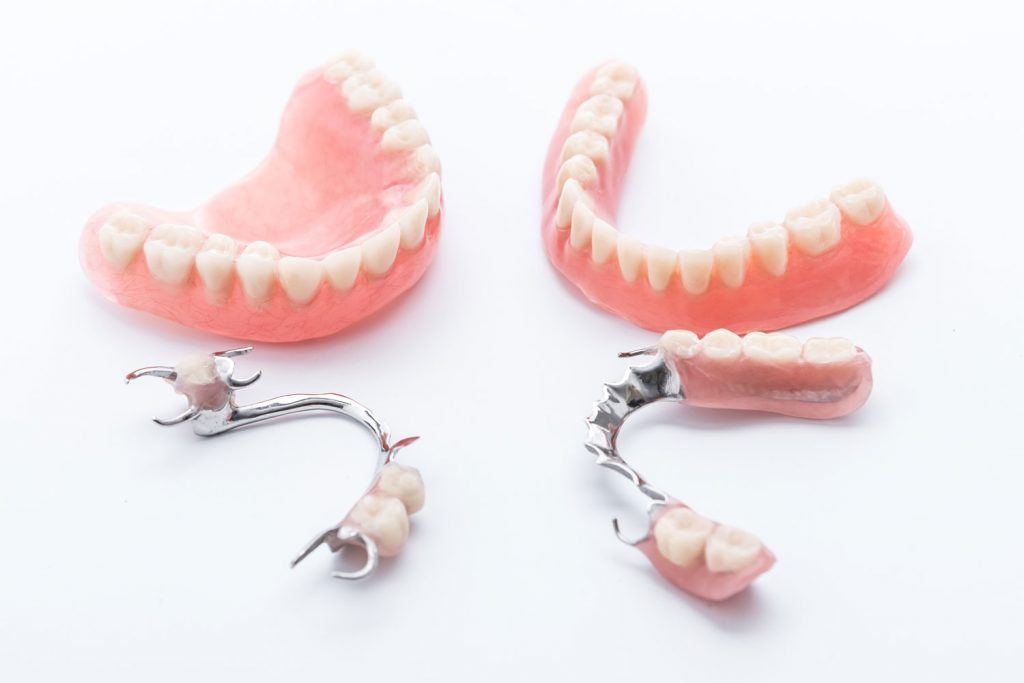
Dentures in Frisco, Texas
A denture replaces missing teeth with a removable appliance that restores your ability to chew, speak clearly, and smile without thinking about it. At Forest Dental Cafe in Frisco, Dr. Demian Kim provides full and partial dentures, flexible partials, immediate dentures, and implant-supported options — and handles simple denture repairs in-house rather than sending you away for a week.
Which type is right for you depends on how many teeth are missing, the condition of the teeth that remain, and how much stability you need. This page walks through all of it.
Types of Dentures We Provide
| Type | Best for | Key point |
|---|---|---|
| Complete (full) denture | All teeth missing in an arch | Rests on the gums and jaw ridge |
| Partial denture | Some natural teeth remain | Clasps to existing teeth for support |
| Flexible partial | Some teeth remain, comfort or appearance is a priority | No visible metal clasps |
| Immediate denture | Teeth are being extracted now | Placed the same day, so you are never without teeth |
| Implant-supported denture | Anyone wanting a denture that does not move | Anchored to implants, not resting on gums |
Most patients arrive assuming there is one kind of denture. There are five, and the difference between them shapes how you eat and how you feel wearing one for the next decade.
Complete and Partial Dentures
Complete dentures replace an entire upper or lower arch. The upper denture covers the palate, which gives it suction and a surprisingly secure hold. The lower denture is horseshoe-shaped to leave room for the tongue, and it relies on the shape of the jaw ridge rather than suction — which is why lower dentures are the ones patients most often describe as loose.
Partial dentures fill in gaps when you still have healthy natural teeth. They clasp onto those teeth for support, which makes them considerably more stable than a full denture. They also do something quietly important: they stop the remaining teeth from drifting into the empty spaces, which is what turns one missing tooth into three over a decade.
Flexible Partial Dentures
A conventional partial uses metal clasps to grip the neighboring teeth. Those clasps work well, but they can be visible when you smile and some patients find them rigid against the gums.
A flexible partial is made from a thin thermoplastic resin instead. Two practical differences:
No visible metal. The framework is gum-coloured and the clasps blend against the tooth, so a partial replacing a front tooth is far less noticeable.
It flexes with your mouth. The material has some give, so it seats more comfortably over an uneven ridge and tends to feel less bulky.
Where a conventional partial is still better: cases needing maximum rigidity, cases where the partial will later be relined or added to, and long spans where flexibility works against you. Dr. Kim will tell you which suits your case rather than defaulting to one.
Immediate Dentures: What to Expect
An immediate denture is made in advance and placed the same day your teeth are extracted, so you never leave the office without teeth. For most patients that alone decides it.
Two things are worth knowing before you choose this route, and we would rather say them now than after:
The fit will change. Your gums and bone reshape considerably as extraction sites heal over three to six months. The denture that fits well on day one will loosen as that happens. This is normal and expected, not a mistake.
A reline is part of the plan. Once healing settles, the denture is relined — refitted to the new shape of your ridge — or a final denture is made. Budget for that step from the beginning rather than treating it as an unwelcome surprise.
The trade-off is straightforward: an immediate denture means you never go without teeth, at the cost of an additional refitting step later. A conventional denture made after healing fits better from the start, but you spend months without teeth. Most patients choose the immediate route, and we think that is usually the right call.
Implant-Supported Dentures
If the thing you dread about dentures is movement, this is the option worth understanding.
An implant-supported denture snaps onto dental implants placed in the jaw rather than resting on the gums. It is still removable for cleaning, but it does not shift while you eat and it does not need adhesive.
What it changes:
- Chewing force. A conventional lower denture transmits a fraction of natural bite force. Implant support restores much more of it, which is the difference between eating a steak and avoiding it.
- Bone preservation. Jawbone shrinks when there are no tooth roots stimulating it. Implants slow that process; a conventional denture does not.
- No adhesive. For many patients this is the daily quality-of-life change that matters most.
The trade-off is cost and time — implant placement requires surgery and several months of healing. It is not the right answer for everyone, and a well-made conventional denture serves many patients very well.
We mention it because patients are often never told it exists. You should know the option is there before you decide.
Getting Used to New Dentures
Honest expectations here save a lot of frustration.
Week one. The denture feels bulky and your mouth produces more saliva than usual. Both settle. Speech feels odd — reading aloud to yourself for ten minutes a day genuinely speeds this up, and most patients sound normal to others long before they feel normal to themselves.
Weeks two to four. Eating is the real adjustment. Start with soft foods cut small, chew on both sides at once rather than one side, and avoid biting straight down with your front teeth. Your tongue and cheeks are learning to hold the denture in place, and that is a skill that develops with practice.
Sore spots are normal and fixable. Almost every new denture needs one or two small adjustments in the first weeks. This is expected — the denture is made on a model, and your mouth is not a model. Call us rather than enduring it, and do not try to file it yourself.
Month two onward. Most patients stop thinking about the denture entirely.
Why Dentures Need Relining Over Time
This is the part almost nobody explains, and it causes more denture complaints than anything else.
Jawbone shrinks when teeth are gone. Tooth roots stimulate the bone around them. Remove the roots and the body gradually resorbs that bone — quickly in the first year, then slowly and continuously for the rest of your life.
The denture does not change shape. Your jaw does. So a denture that fit perfectly two years ago now rocks, slips, or rubs — not because it was made badly, but because the ridge it was made for is no longer the same shape.
A reline rebuilds the fitting surface to match your current ridge. Most patients need one every few years. It is far cheaper than a new denture and it is the difference between a denture that works and one that lives in a drawer.
If yours has started slipping, or you have quietly increased how much adhesive you use, that is the signal. Adhesive is meant to add confidence, not to compensate for a denture that no longer fits.
Denture Repairs
A broken denture is an emergency in every way that matters. You cannot eat, and you cannot go to work with a gap in your smile.
We handle simple repairs in-house — a clean break, a popped tooth, a broken clasp — so you are not without your denture for a week. Call us as early in the day as you can and we will tell you honestly whether it is a same-day fix.
More complex cases go to the lab, including repairs to the metal framework of a partial, cases needing a full reline, and dentures that have broken more than once in the same place. We will tell you which category yours falls into when we see it.
One request: do not repair it yourself. Superglue is toxic in the mouth, it makes a proper repair much harder, and drugstore repair kits routinely turn a straightforward fix into a remake. Bring in the pieces — all of them.
Caring for Your Dentures
- Rinse after eating and brush daily with a soft denture brush and non-abrasive cleaner. Regular toothpaste is too abrasive and creates micro-scratches that hold stain.
- Never use hot water. It warps the acrylic permanently.
- Soak overnight in water or denture solution — drying out changes the shape.
- Handle over a towel or a filled sink. Most denture fractures happen on a bathroom floor.
- Keep seeing us. Even with no natural teeth, we check your gums, ridge, and the denture’s fit — and screen the soft tissues for anything that needs attention.
Our Five-Year Guarantee
Dr. Kim provides a five-year guarantee on the dental work he performs, including dentures. The industry standard is considerably shorter, and many practices offer no written guarantee at all.
Dentures are a fair test of that. A denture either works every day for years or it becomes something a patient stops wearing. The difference is usually decided in the fitting appointments, not the lab work — which is why we take the extra try-in rather than rushing to delivery.
Specific terms are reviewed with you in writing as part of your treatment plan, before you agree to anything.
Paying for Dentures
Cost depends on the type, whether extractions or a reline are involved, and the materials used. Dr. Kim gives you the full cost in writing at your consultation, before you commit.
- Dental insurance. Dentures are a restorative procedure, so most plans cover a portion. Many plans also have a replacement frequency limit — typically once every five years. We verify your specific benefits before treatment begins.
- CareCredit. Monthly payment plans, including interest-free options for qualifying patients.
- Our in-house membership plan. For patients without dental insurance. Includes two cleanings, two exams, necessary x-rays, and a discount on treatment. Plans start at $100 per year.
Call 214.469.1001 and we can walk through the options.
Frequently Asked Questions About Dentures
How long does it take to get dentures? A conventional denture typically takes several appointments over four to six weeks — impressions, a bite record, a try-in, and delivery. Immediate dentures are made in advance and placed the day your teeth are extracted.
Will people be able to tell I am wearing dentures? A well-made denture is difficult to identify. Tooth shape, shade, and arrangement are all chosen during the try-in, and slight natural irregularity is what makes a denture read as real teeth. Flexible partials avoid visible metal clasps entirely.
Can I eat normally with dentures? Most foods, yes — with an adjustment period. Chewing technique changes: you chew on both sides simultaneously rather than one side, and you avoid biting hard foods with the front teeth. Very hard or very sticky foods remain difficult with a conventional denture. Implant-supported dentures handle considerably more.
Do I have to use denture adhesive? A well-fitting denture should hold without much adhesive. A small amount for confidence is fine. If you find yourself needing more and more of it, the denture likely needs relining — that is the message your mouth is sending.
How often do dentures need replacing? Typically every five to ten years, with relines in between as your jaw changes shape. Worn teeth, repeated breaks, and a fit that relines can no longer correct are the usual signals.
Can you repair my denture the same day? Simple breaks, popped teeth, and broken clasps are often same-day. Metal framework repairs and full relines go to the lab. Call early in the day and we will tell you honestly which yours is.
Should I sleep with my dentures in? Generally no. Your gums need the rest, and leaving them out overnight reduces irritation and fungal infection. Soak them in water or denture solution instead.
Do I still need dental checkups if I have no natural teeth? Yes. We check the fit of the denture, the health of your gums and ridge, and screen the soft tissues. Bone loss continues whether or not you have teeth, and catching a fit problem early prevents sore spots and breaks.
What is the difference between a flexible partial and a regular one? A conventional partial has a rigid framework with metal clasps. A flexible partial is made from a gum-coloured thermoplastic with no visible metal, and it has some give to it. Flexible is often more comfortable and more discreet; conventional is more rigid and easier to modify later.
Schedule a Denture Consultation in Frisco
Forest Dental Cafe serves patients throughout Frisco, Little Elm, The Colony, Prosper, and north Plano. We offer evening appointments and every-other-Saturday hours.
Whether you are getting your first denture, replacing one that no longer fits, or dealing with a break that needs fixing today, call and we will tell you straight what your options are.
Call 214.469.1001 or request an appointment online.
8075 FM 423, Suite 110, Frisco, TX 75036